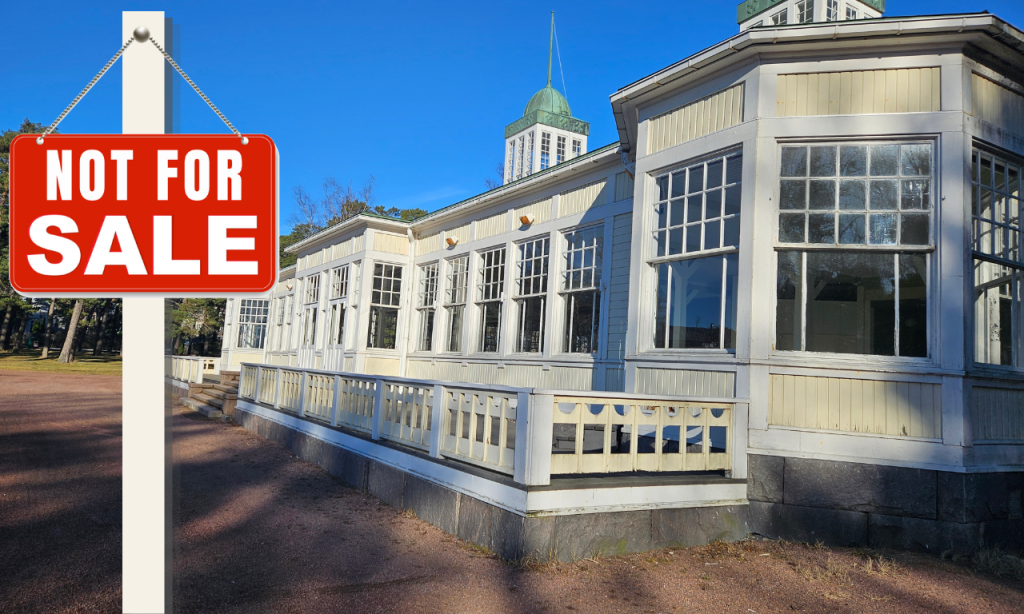
Opinions differ on the priorities for the future of Hanko Casino, but not on its goals: City Council Chair Sami Laine, City Board Chair Edvard Lindfors, and Mayor Simon Store emphasize that the Casino is a cultural and historical landmark in Hanko and an integral part of the city’s identity.
In their view, the Casino is not merely a commercial property. They all believe that renovating the building will require either loan financing or external funding, and that the current level of investment alone is not sufficient. The clear direction is to seek a public and/or private partnership in such a way that the city and the residents of Hanko retain strong decision-making power over the casino’s future.
Open the summary table containing a summary of the responses.
We asked four questions:
1. Culture or the economy?
Original question: “Do you view the Hanko Casino primarily as a cultural and historical landmark or as a commercial property, and how do you think this perspective influences the decision between renovating and selling it?”
Sami Laine: The Casino is a cultural-historical landmark. The renovation will not pay for itself through the revenue generated by the building's operations. The decision between renovating and selling depends on whether the residents of Hanko are willing to use city funds annually to maintain this cultural-historical landmark in good condition and under city ownership, and how much funding they are prepared to allocate for this.
Edvard Lindfors: Hanko Casino is a cultural-historical landmark and a strong part of both Hanko's brand and identity. This naturally means that its full value to Hanko is difficult to measure solely by financial metrics.
Simon Store: The building is undeniably very valuable from a building preservation perspective. It has also served as a restaurant and an event venue (the building itself and the plot). The building must be renovated. I will not comment on whether the city or a private entity should carry out the renovation.
Summary: Everyone primarily views the Casino as a cultural-historical landmark: Laine emphasizes that the renovation will not generate profit and the decision depends on taxpayer funds; Lindfors sees significant image and brand value in the Casino. Store highlights its preservation value and the necessity of renovation (by the city or a private entity). Common stance: culture first, with financial constraints as a reality.
2. Investment and Funding
Original Question: “How large an economic investment (magnitude in euros or as a percentage of the city's investment budget) would you consider justified for the city to renovate the Casino itself without jeopardizing the funding of other services? Is it possible to apply for / obtain funding, or partial funding, within a reasonable timeframe?”
Sami Laine: In a good year, the city can afford to invest approximately four million euros. This only covers a portion of the city's annual investment needs. This is evident not only from the condition of the Casino but also, for example, from the condition of the streets. Therefore, every euro invested in the Casino, without taking out a loan, is a euro taken away from another project. At this stage, I cannot comment on obtaining external funding, but I dare say that the renovation would have to be carried out with borrowed money to ensure other mandatory investments can be made. Since the word 'loan' often carries a negative connotation, it must be stated here that taking out a loan is a completely normal practice for anyone who owns a building and undertakes significant repairs to it.
Edvard Lindfors: Currently, with state subsidies still in deficit, all investments jeopardize the funding of other services if no external funding is available. There is interest in and possibility to apply for external funding, but a large portion of such applications typically funds operations, not the renovation itself. All possibilities have already begun to be explored. The Casino's renovation and development project should be viewed with at least a 5-year timeline, if not longer. Preparing funding applications requires significant effort, and they should also include a long-term plan.
Simon Store: If the city were to undertake the renovation itself and record it on its balance sheet, this would be financed 100% by borrowed money. Depreciations would burden the operating budget for many years. The magnitude will become clear once the condition assessments are completed.
Summary: The city's own resources are insufficient: Laine limits it to a maximum of €4 million/year and highlights the need for a loan; Lindfors warns of a state subsidy deficit and a 5+ year external funding application process; Store mentions 100% reliance on loans and the burden on the operating budget (awaiting condition assessment). Common stance: a loan or partnership is essential, without jeopardizing other services.
3. Conditions for Sale
Original Question: “If the building were to be sold to a private operator, what three conditions would you consider absolutely essential to ensure that the Casino's historical value, public access for residents, and Hanko's brand remain acceptable?”
Sami Laine:
1. The land would not be sold, and the entire Casino park area would remain available for use by Hanko residents.
2. The buyer would commit to renovating the building within a specified period from the signing of the sales agreement,
adhering to the implementation plans approved by the City of Hanko.
3. The buyer would have the right to cancel the sale if the deviation procedure or zoning plan amendment required for a potential change in the buildings' intended use did not become
legally binding. While the cancellation clause is in effect, the buyer would be obligated to maintain the building in at least its current condition.
Edvard Lindfors: The Casino must remain for public benefit and accessible to all who love Hanko. The operator should commit to renovating the Casino, its condition must not deteriorate, and the city should be able to react if the operator does not follow the conditions.
Simon Store: The building should be in use, but currently it is not. Bringing it into use requires money, and it has not fit into the city's investment budget, as the city has had to reduce its high debt burden. Furthermore, schools and daycare centers have had to be maintained. The city's investment budget has been set to a minimum, especially because as a city, we have to pay state subsidies to the government. If state subsidies were at the same level compared to other municipalities in Uusimaa, renovations could be prioritized in a completely different way!
Summary: Protection is required for sale: Laine lists the preservation of the land, a renovation commitment, and a cancellation clause with minimum maintenance; Lindfors emphasizes public benefit use, renovation obligation, and oversight; Store focuses on bringing it into use (with budget for schools/debt burden taking precedence). Common stance: historical value, public access for residents, and oversight must be secured.

4. Personal Stance on the Future Solution
Original Question: “Which of the following options currently aligns most closely with your personal view:
A) the city renovates and retains ownership of the Casino,
B) the city seeks a public-private partnership for the renovation,
C) the city sells the building with clear conditions, or
D) something else, and why?”
A) The city will renovate and retain ownership of the Casino,
B) The city will seek a public-private partnership for the renovation,
C) The city will sell the building under clear terms and conditions,
D) Something else, and why?”
Sami Laine: Partnerships are a good way to develop operations, share costs, and build community. Before the municipal elections, I was firmly of the opinion that the Casino should rather be sold than kept by the city, as its revenues would not cover the renovation costs. However, by council decision, I am committed to exploring different possibilities for renovating the Casino, and in such a case, the starting point cannot be to investigate merely for appearances, only to sell it regardless.
Edvard Lindfors: The city would need help with the renovation and also with the building's use and content production. For me, the most important thing is that the city, and through it the residents of Hanko, would have the final say.
Simon Store: I cannot comment on this yet, as the investigation data is still incomplete. Furthermore, the city's entire investment plan must be viewed comprehensively; what can be afforded after ensuring functional and healthy facilities for schools and daycare centers. Additionally, in the coming years, investments will be made, for example, in the sufficiency of domestic water and the construction of business plots, etc.! The use of money in a municipality is a comprehensive matter that must also be justifiable according to municipal law.
Summary: Laine leans towards a Public/Private partnership with cost-sharing (committed to investigations); Lindfors favors cooperation in renovation/use with the city retaining decision-making power; Store will not comment before the investigations and the overall investment plan are complete. Common stance: partnership or investigations are realistic, not pure self-renovation or sale.
Hanko Casino 2026 Schedule
According to a press release from Edvard Lindfors, the City Council set the following timeline for the decision on the Casino:
- Jan–Mar: Condition surveys and cost estimates for urgent repairs (in progress; €30,000 allocated).
- February–June: Urgent repairs (€50,000 allocated), study on intended use (consultation with Hanko residents), City Council evening session, studies on funding and cooperation.
- May–September: Rental options (private events, champagne bar, etc.).
- Aug–Nov: 2027 budget, final decision.